Jinnah Avenue Commercial Property: Buying for Frontage and Footfall
Jinnah Avenue is a frontage address before it's anything else. Here's how Jinnah Avenue commercial property works — why exposure is the asset, and what to check before you buy.
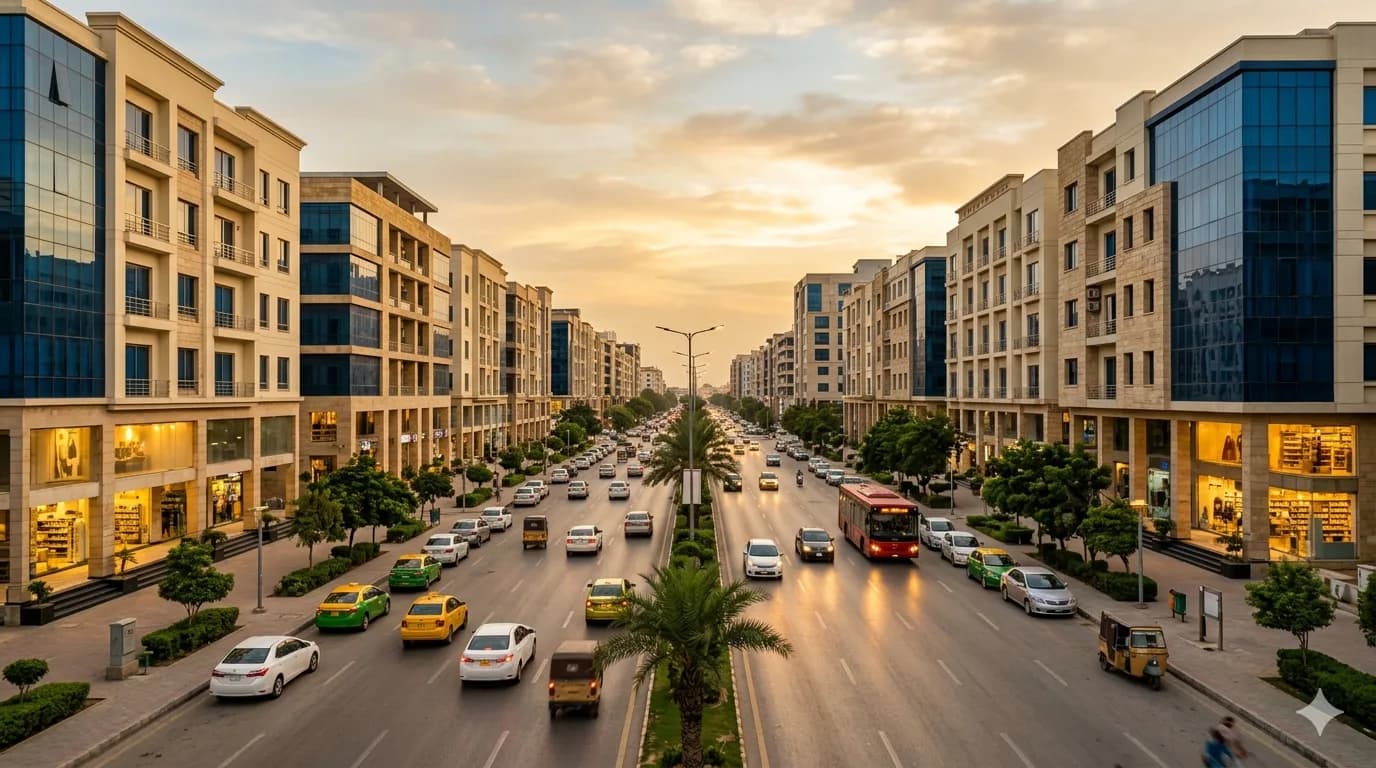
Some addresses sell you a building. Jinnah Avenue sells you an audience. Jinnah Avenue commercial property is a frontage play before it's anything else — wide, arterial and built for visibility, the kind of corridor where a unit's worth comes as much from who drives past it as from the space inside. For the right buyer, that exposure is the whole point.
This is a corridor where presence is the product. A retail or showroom unit here is buying eyeballs, and a mixed-use building is buying both exposure downstairs and a rental story upstairs. The logic is straightforward, but the execution — which position, which floor, which frontage — is where deals are won or lost.
Commercial frontage Karachi buyers pay a premium for
On an arterial like this, commercial frontage Karachi buyers chase is the asset itself. You're not paying for square footage in the abstract; you're paying for how many people see your unit and how easily they can reach it.
What drives value on the avenue:
- Position on the corridor — proximity to a junction or commercial cluster lifts footfall
- Frontage width and visibility — a unit that's seen beats a unit that's merely present
- Floor — ground-floor retail commands a clear premium over upper levels
- Access and parking — ease of stopping turns passing traffic into actual customers
Because these factors compound, two units on the same stretch can be priced very differently and both be reasonable. Reading that gap is what separates a strong buy from an ordinary one.
Mixed-use property Jinnah Avenue investors weigh
Beyond pure retail, the corridor's mixed-use stock has its own appeal. Mixed-use property Jinnah Avenue investors weigh combines a commercial ground floor with residential or office space above — exposure and footfall feeding a built-in rental story.
The attraction for an investor is twofold. The retail level captures the corridor's traffic, while the upper floors generate steadier rental demand from tenants who value the access and visibility of an arterial address. A comparable format elsewhere in our portfolio — Saima Center Point on M.A. Jinnah Road, with apartments above an air-conditioned mall — shows how well retail-below, homes-above can work on a high-traffic spine. On the right stretch of Jinnah Avenue, the same logic applies.
Who Jinnah Avenue suits
The corridor fits commercial buyers who need presence — retail, showroom or office space where being seen matters — and investors looking at mixed-use stock with a rental story attached. If your business or your tenant depends on visibility and access, this is the kind of address built for it.
It's a weaker fit for buyers after a quiet residential setting or a low-traffic street. The defining feature here is exposure, and that comes with the noise and movement of an arterial road.
What to check before you buy
Frontage value is real, but it rewards diligence:
- Confirm the exact position — footfall and visibility change meaningfully along the corridor.
- Match floor to price — don't pay ground-floor retail rates for an upper unit.
- Verify title, approvals and permitted use — commercial and mixed-use carry specific paperwork.
- Test the demand assumption — observe the traffic yourself, and check real letting rates for any residential element.
Apply these location-specific checks when assessing a development. Lateef Properties can discuss the projects currently available; an area guide does not imply that inventory is available in every neighbourhood.
If a high-visibility commercial or mixed-use opportunity fits your plan, start here.
Ready to act on this?
Browse curated Karachi inventory.
Compare projects from pre-launch to ready to move by location, type and budget, or ask an advisor about current developer availability.